Should You Repair or Replace Your Commercial Roof in Fort Worth?
Commercial roofing repair in North Texas faces harsher conditions than in most parts of the country. Heat, hail, seasonal storms, thermal cycling, and tenant-related wear combine to shorten roof lifespans. When leaks surface or aging becomes visible, property managers must decide whether to repair or replace the roof entirely. That decision carries real consequences for operating budgets, long-term asset value, and tenant satisfaction.
This guide provides a clear, practical framework to help you evaluate when repair suffices and when replacement is the responsible choice. It reflects the work and real-world experience of Texcore Construction, which has inspected and serviced hundreds of commercial roofs across Fort Worth, Arlington, Mansfield, and throughout the wider DFW area. The goal: reduce risk, preserve value, and extend roof life when possible — replace only when necessary.
The Real Cost of Making the Wrong Decision
Commercial roof failure rarely happens suddenly. It usually starts with a seam opening, an overlooked penetration, or poor drainage that goes unaddressed. What you do next makes all the difference.
Repairing a Roof That Should Be Replaced
Terming an aging but patchable roof as “good enough” often leads to:
- recurring leaks throughout the year
- emergency repair expenses
- interior damage, mold remediation, ceiling tile replacement
- tenant complaints, potential lease disruption
- insulation saturation and structural decay
In Fort Worth, heat, UV exposure, and periodic hail storms accelerate aging — making a delayed replacement far more costly than an early, strategic one.
Replacing a Roof That Could Have Been Repaired
On the flip side, some replacements are unnecessary. A single leak near an HVAC curb or wall penetration does not automatically justify a full tear-off. When replacement is recommended without evidence of widespread failure, the building owner risks deploying significant capital without adequate return on investment.
The right decision is always backed by documentation. A small leak does not equal a failing roof.
When Commercial Roofing Repair Makes Sense
Many commercial roofs perform reliably for years with correct repairs and maintenance. The key is identifying when the issue is truly isolated.
Roof Is Under 10 Years Old
Most commercial roof membranes are designed for 15–25 year service life under normal conditions. When a roof is still in the first third of that lifespan, membrane condition is usually sound. Repairing flashing, sealing around penetrations, patching small punctures, or correcting localized ponding often restores full functionality.
Damage Affects Less Than 20% of the Roof
If damage is limited to a small portion of the roof — a corner with ponding, one long seam, or a group of penetrations around a piece of equipment — repairing just that area is almost always more cost-effective and efficient than replacing the whole roof.
A Clear, Identifiable Leak Source Exists
Repair works best when there is a visible, traceable cause. Common sources include:
- loose or deteriorated flashing
- mechanical punctures
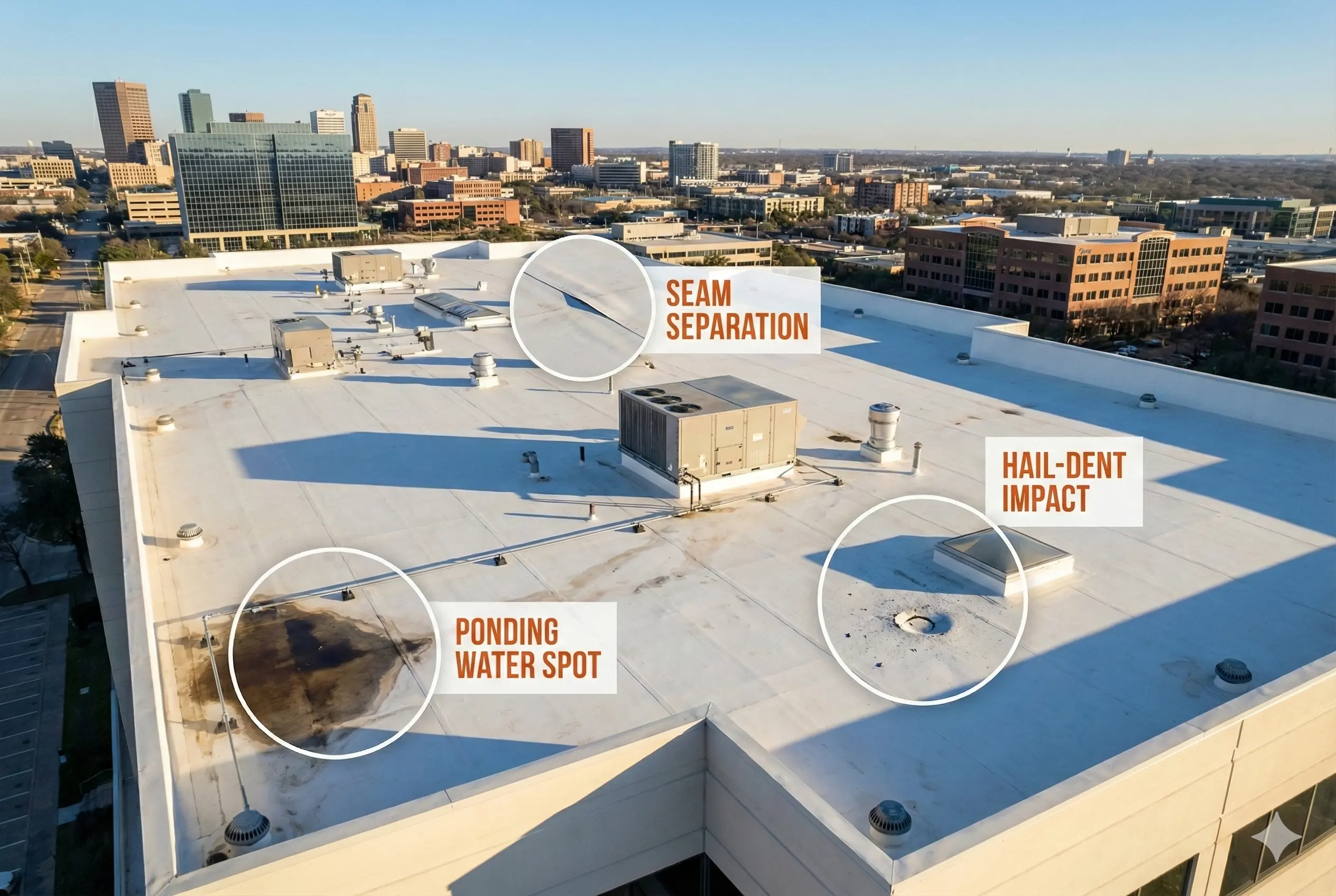
- seam separation
- back-out fasteners in mechanically attached roofs
When you know exactly where the leak comes from, patching or targeted repair is straightforward and reliable.
Roof Has Been Properly Maintained
Roofs that receive regular maintenance — biannual inspections, clean scuppers and drains, timely minor repairs — respond much better to targeted repair. In Fort Worth’s climate, a well-maintained roof often exceeds its rated lifespan. Poorly maintained roofs rarely do.
Texcore provides a five-year labor warranty on all projects, including repairs and maintenance, giving property managers confidence that work will last when done correctly.
When Full Replacement Is the Right Move
Repair has limits. When deterioration spreads or structural issues emerge, replacement is the only responsible option.
Roof Age Reaches 15–20 Years or More
Age is the most reliable predictor of failure, especially in North Texas where UV exposure, heat cycling, and hail accelerate wear. While commercial roofing system lifespans vary, typical ranges under local conditions are:
- TPO: 15–20 years
- EPDM: 18–25 years
- Modified Bitumen: 15–20 years
- Built-up Roofing (BUR): 18–25 years
- Metal roofs: 25–40 years
When a roof approaches those ranges — especially for TPO or modified bitumen — and shows signs of widespread wear, replacement becomes a strategic, long-term investment.
Recurring Leaks in Multiple Locations
If leaks appear regularly in new areas despite prior repairs, the membrane has lost structural integrity. Evidence such as:
- leaks in different seasons
- water intrusion at various penetration points
- increasing ceiling stains in multiple zones
… indicates systemic failure. Continued patchwork repair wastes money in the long run.
Code or Warranty Conditions Require Replacement
Sometimes partial repairs do not meet code or warranty requirements. Examples include:
- repairs exceeding a certain percentage of the roof area
- insulation R-values that no longer meet updated energy codes
- voided manufacturer warranties due to age or previous unauthorized modifications
In those cases, replacement is not optional — it’s mandatory.
Insulation or Deck Saturation
Once water penetrates beyond the membrane into insulation or deck layers, drying is often ineffective. Indicators include:
- moisture detected via infrared scans
- musty odors indoors
- sagging roof areas or soft spots
- mold or water damage in ceiling systems
At that point, replacement is the only viable solution to avoid long-term structural damage or health hazards.
Fort Worth–Specific Factors That Influence the Decision
Local climate and weather patterns directly affect roof performance. A commercial roofing strategy that works elsewhere may fail here.
Frequent Hail Exposure
Fort Worth and the greater DFW area experience frequent hail events. Even minor surface dimples can signal deeper membrane fractures, compromised insulation, or hidden pathways for moisture intrusion. For commercial roofing, Texcore recommends:
- surface inspection within 72 hours of a hailstorm
- infrared moisture scanning
- photo documentation to support insurance claims
- a clear repair vs replacement recommendation based on findings
Hail remains a top justification for full replacement rather than patchwork.
Heat and UV Stress
Summers in Fort Worth often mean sustained temperatures above 100°F. Combined with high UV exposure, this accelerates membrane degradation:
- adhesives weaken under heat
- seams separate due to expansion/contraction cycles
- surface cracking increases
- reflective membranes lose effectiveness over time
The result: a roof at 12 years old in Fort Worth may degrade as quickly as one at 15 or 16 years in milder climates.
Wind Uplift and Storm Damage
Seasonal storms can bring strong winds that challenge the structural integrity of a commercial roofing system:
- membrane uplift at edges and corners
- detachment of edge metal and flashings
- fastener failures in mechanically attached systems
When uplift damage exceeds local thresholds — or damage appears across multiple roof zones — replacement is often justified.
The Texcore Inspection Process
Choosing between repair or replacement for commercial roofing should be based on solid data, not guesswork. Texcore’s process ensures clarity, documentation, and actionable recommendations.
Emergency Stabilization
When a leak is active, Texcore responds the same day to:
- stop water intrusion
- apply temporary patches or tarping when appropriate
- protect critical interior areas
This reduces interior damage while full assessment takes place.
Complete Commercial Roofing Evaluation
A full inspection includes:
- membrane condition review
- flashing and penetration inspection
- drainage and roof slope analysis
- infrared moisture scanning
- deck condition assessment if indicated
- detailed photo documentation covering the entire roof
This delivers a comprehensive overview of current roof health.
Commercial Roofing Repair vs Replacement Report
Within 24 hours of inspection, Texcore provides property managers with:
- a detailed repair plan (scope, materials, cost, expected life extension)
- a full replacement plan (system options, insulation upgrades, warranties, life expectancy)
- a hybrid phased plan when a full replacement does not align with current budgets
This clarity allows for informed, strategic decision-making.
Support Through the Entire Decision Process
Texcore also assists with:
- insurance coordination and claim documentation
- budget planning and scheduling
- tenant notifications and minimizing business disruption
- compliance with local building codes and energy standards
When it comes to commercial roofing, Texcore handles complexities so property managers don’t have to.
Common Commercial Roofing Systems in Fort Worth
A clear understanding of a commercial roofing systems ensures accurate expectations for performance, maintenance, and replacement timing.
TPO Roofing
- Lifespan: ~15–20 years under Fort Worth conditions
- Benefits: Reflective surface helps reduce cooling costs
- Common issues: seam failure, UV degradation, seam separation
EPDM (Rubber Membrane)
- Lifespan: ~18–25 years
- Benefits: Flexible and durable under thermal stress
- Common issues: adhesive seam failure, small punctures, shrinkage over time
Modified Bitumen
- Lifespan: ~15–20 years
- Benefits: Multi-layer protection, strong durability
- Common issues: blistering, granule loss, seam aging
Built-Up Roofing (BUR)
- Lifespan: ~18–25 years
- Benefits: Thick, multiple plies offer redundancy
- Common issues: alligatoring, substrate saturation, ply separation
Metal Roofing Systems
- Lifespan: ~25–40 years, depending on gauge and maintenance
- Benefits: Durability, longevity, resistance to fire and weather
- Considerations: expansion/contraction stresses, fastener maintenance
Texcore supports all common commercial roofing systems — from flat TPO and EPDM to modified bitumen, built-up, and metal systems.
How to Extend the Life of a Commercial Roofing System
Repair and replacement are only part of the story. A proactive maintenance plan significantly boosts roof life and reduces overall costs.
Biannual Inspections
Schedule inspections in early spring (March–April) and early fall (September–October). Following storm seasons, add targeted inspections to catch hail or wind damage early.
Drainage Maintenance
Clear scuppers, drains, and downspouts regularly. Standing water accelerates membrane breakdown and can cause structural issues over time.
Prompt Repairs for Minor Issues
Minor leaks, flashing failures, or seam separation should be addressed promptly. Small issues grow fast — and timely repairs save big over the long run.
Roof Coatings
For roofs between 10 and 15 years showing only surface wear, elastomeric or reflective coating systems can extend useful life by 5 to 10 years at a fraction of replacement cost. Evaluate coatings only when membranes are structurally sound and insulation is dry.
Project Timelines, Costs, and Tenant Impact
Clear expectations help manage budgets and tenant coordination.
Repair Projects
- Typical Duration: 1–3 days
- Typical Cost Range: $2,500–$15,000 depending on scope and access
- Tenant Impact: Minimal — often completed during business hours with prior notice
Replacement Projects
- Typical Duration: 2–6 weeks depending on building size and complexity
- Cost Estimate: $4.50–$12.00 per square foot, depending on system type and insulation upgrades
- Tenant Impact: Moderate — tear-off and installation generate noise; interior disruption is minimal when properly scheduled
Get a Professional Roof Assessment from Texcore Construction
Do not guess about your commercial roof’s condition. Let Texcore provide a data-driven repair vs replacement recommendation, backed by full inspection, moisture scanning, documentation, and no-pressure proposals.
Call (940) 229 1940
Email contact@texcoreconstruction.com
Text photos of your roof for a fast assessment
Serving Fort Worth, Arlington, Keller, Mansfield, Southlake, Roanoke, Trophy Club, Aledo, and the surrounding Dallas–Fort Worth metro area.