Hail Damage Roofing Contractors: Expert Selection Guide
Severe hailstorms can devastate roofing systems in minutes, leaving property owners scrambling to find qualified professionals who can assess damage, navigate insurance claims, and restore structural integrity. The challenge intensifies when unqualified contractors flood affected neighborhoods, making promises they can't keep and disappearing before warranties matter. Choosing the right hail damage roofing contractors determines whether your roof receives proper restoration or becomes a costly, ongoing problem. Understanding what separates experienced professionals from opportunistic storm chasers protects your property investment and ensures quality repairs that stand the test of time.
What Qualifies Legitimate Hail Damage Roofing Contractors
Professional credentials form the foundation of contractor legitimacy. Licensed roofing contractors carry proper state and local permits, maintain comprehensive liability insurance, and hold workers' compensation coverage that protects you from liability if accidents occur on your property. These fundamental requirements separate established businesses from unlicensed operators who vanish after collecting payment.
Certification and training matter significantly in hail damage assessment. Reputable hail damage roofing contractors invest in specialized education through programs offered by roofing manufacturers and industry organizations. The National Roofing Contractors Association provides detailed procedures for assessing hail damage, which qualified contractors follow to ensure accurate evaluations and appropriate repair recommendations.
Verification Steps Before Signing Contracts
Before committing to any contractor, property owners should complete specific verification steps:
- Request current insurance certificates directly from the contractor's insurance carrier
- Verify license numbers through state licensing boards or local building departments
- Check business registration and confirm physical office locations
- Review Better Business Bureau ratings and complaint histories
- Obtain references from projects completed at least two years prior
Local presence distinguishes legitimate contractors from temporary operations. Established companies maintain permanent offices, employ local crews, and build reputations within their communities over years or decades. As emphasized in discussions about selecting reputable roofing companies after hailstorms, contractors with local roots have more accountability and accessibility for warranty issues or follow-up concerns.

Red Flags That Signal Contractor Problems
Storm chasers represent one of the roofing industry's most persistent problems. These contractors follow severe weather, offering quick inspections and promising to handle everything with minimal homeowner involvement. They typically lack proper licensing, carry inadequate insurance, and disappear once they collect payments or complete substandard work.
Warning signs of problematic contractors include:
- Pressure tactics demanding immediate signatures or deposits
- Offers to waive insurance deductibles, which violates insurance contracts
- Door-to-door solicitation immediately following storms
- Out-of-state license plates and temporary phone numbers
- Requests for full payment upfront before work begins
- Unwillingness to provide written estimates or detailed contracts
The practice of waiving deductibles deserves special attention. While it sounds attractive, this approach is illegal in most states and constitutes insurance fraud. Contractors who waive deductibles typically inflate claims, provide substandard materials, or cut corners on installation to compensate for the "discount." Property owners who participate, even unknowingly, risk insurance policy cancellation and potential legal consequences.
Documentation and Contract Requirements
Professional hail damage roofing contractors provide comprehensive written documentation before starting work. Detailed contracts should specify materials by manufacturer name and product line, include complete scope of work descriptions, establish payment schedules tied to completion milestones, and outline warranty terms for both materials and labor.
| Contract Element | What to Verify | Why It Matters |
|---|---|---|
| Material specifications | Exact manufacturer, product line, color | Ensures quality matches what you approved |
| Payment schedule | Tied to completion phases, not calendar dates | Protects you from paying for incomplete work |
| Labor warranty | Minimum five years, written guarantee | Covers installation defects after completion |
| Project timeline | Start date, estimated completion, weather provisions | Sets expectations and accountability |
| Permit responsibility | Contractor obtains all required permits | Ensures legal compliance and inspection access |
Written estimates should break down costs by category rather than providing single lump-sum figures. Itemized pricing for materials, labor, tear-off, disposal, and permits enables property owners to compare proposals accurately and understand where their money goes.
The Insurance Claims Process With Professional Contractors
Navigating insurance claims for hail damage requires specific expertise that separates qualified contractors from general roofers. The best hail damage roofing contractors understand policy language, know what insurance adjusters look for during inspections, and document damage in ways that support legitimate claims without exaggeration.
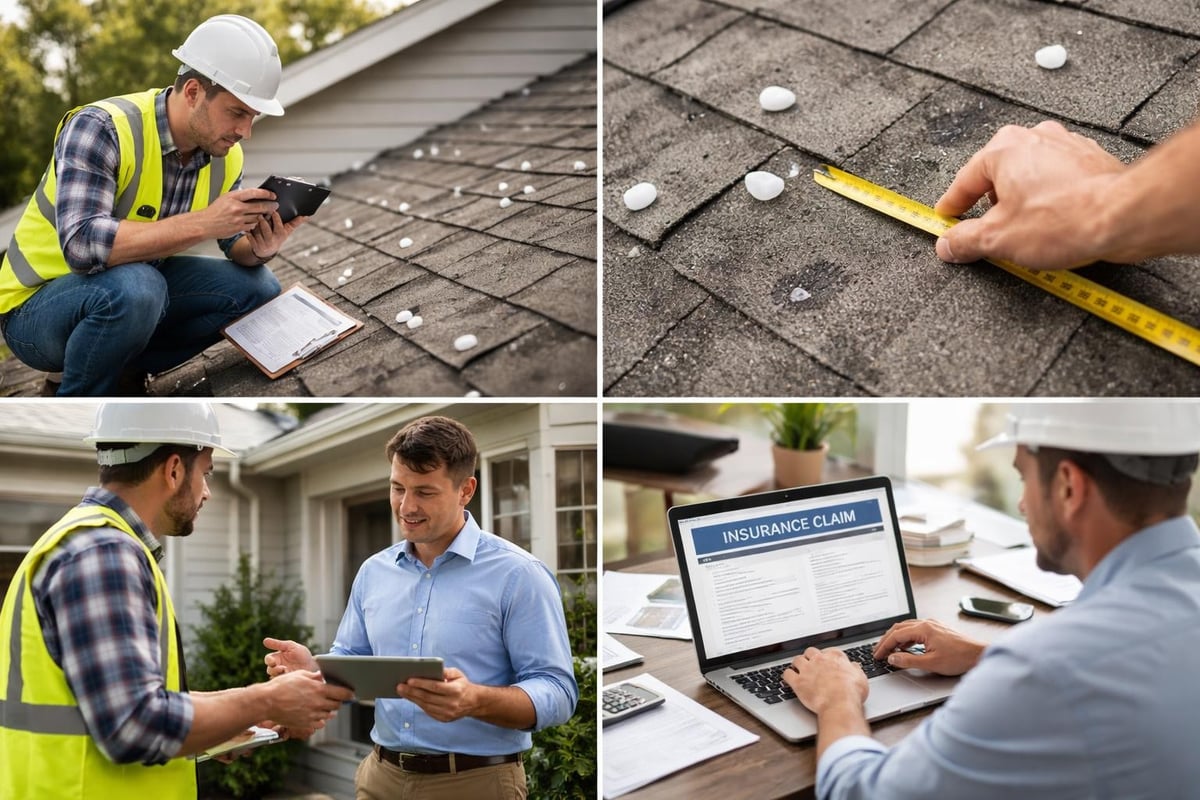
Professional documentation begins with thorough inspections that identify all damage types. Hail impact creates distinct patterns on different roofing materials, from bruising on asphalt shingles to dents in metal components and fractures in composition materials. Experienced contractors photograph damage from multiple angles, measure hail strike diameters, and note damage density across different roof sections.
The timing of insurance adjuster meetings matters significantly. Property owners benefit when their contractor attends the insurance inspection, pointing out damage that adjusters might overlook and ensuring accurate assessment of repair scope. However, ethical contractors never pressure homeowners to file claims when damage doesn't warrant replacement or attempt to inflate damage reports. Financial considerations discussed in hail damage insurance claims analysis highlight why honest assessment protects homeowners from unnecessary rate increases.
Working With Adjusters and Claim Outcomes
Insurance adjusters work for insurance companies, not property owners. Their job involves minimizing claim payouts while honoring legitimate damage coverage. Understanding this dynamic helps property owners appreciate the value of having knowledgeable contractors who advocate for complete, accurate damage assessment.
Common adjuster tactics include:
- Attributing damage to normal wear rather than storm events
- Underestimating the number of damaged shingles requiring replacement
- Excluding necessary components like underlayment or flashing
- Recommending repairs when full replacement is warranted
- Offering depreciated value without explaining recoverable depreciation
Qualified hail damage roofing contractors counter these tactics with factual documentation, industry standards references, and professional experience. They prepare supplemental claims when initial settlements fall short, providing additional evidence that justifies proper repair scope and costs. When working with roofing insurance claims specialists, property owners gain advocates who understand both roofing systems and insurance processes.
Evaluating Contractor Estimates and Proposals
Professional proposals contain significantly more detail than simple price quotes. Comprehensive estimates describe the complete scope of work, from initial tear-off through final cleanup, specifying every material and process involved. This transparency enables informed decision-making and prevents surprise costs during project execution.
Material quality represents a critical comparison point across different contractor bids. Lower prices often reflect lower-grade materials that compromise long-term performance. Property owners should compare shingle ratings, underlayment types, fastener specifications, and ventilation components across proposals to ensure equivalent quality levels.
Understanding Price Variations
Significant price differences between contractor bids warrant investigation rather than automatic selection of the lowest bidder. Legitimate reasons for price variations include:
- Different material quality levels and manufacturer warranties
- Varying labor costs based on crew experience and training
- Inclusion or exclusion of critical components like ice and water shield
- Different waste disposal methods and site cleanup standards
- Comprehensive versus minimal warranty coverage
Suspiciously low bids often indicate corners that will be cut during installation. These might include inadequate fastener quantities, skipped underlayment layers, improper ventilation, or use of non-manufacturer-approved materials that void product warranties. The true cost of cheap roofing emerges years later when premature failures require complete replacement.
Technical Expertise in Hail Damage Assessment
Accurate hail damage assessment requires specialized knowledge that extends beyond general roofing experience. NRCA protocols for evaluating hail-damaged steep-slope roof systems outline systematic approaches that qualified contractors follow to identify and classify damage severity.
Different roofing materials exhibit distinct hail damage characteristics. Asphalt shingles show bruising where granules are displaced, revealing the underlying mat. Metal roofing develops visible dents that compromise protective coatings. Tile roofs crack or fracture from impact force. Wood shakes split along grain lines. Professional hail damage roofing contractors recognize these material-specific indicators and understand when damage compromises system integrity versus remaining purely cosmetic.
| Roofing Material | Hail Damage Indicators | Replacement Threshold |
|---|---|---|
| Asphalt shingles | Granule loss, mat exposure, bruising | 8-10 impacts per 100 sq ft |
| Metal panels | Denting, coating cracks, seam separation | Penetration or widespread denting |
| Clay/concrete tile | Cracks, chips, complete breaks | Any crack extending through tile |
| Modified bitumen | Surface punctures, membrane tears | Any puncture compromising waterproofing |
Advanced Inspection Techniques
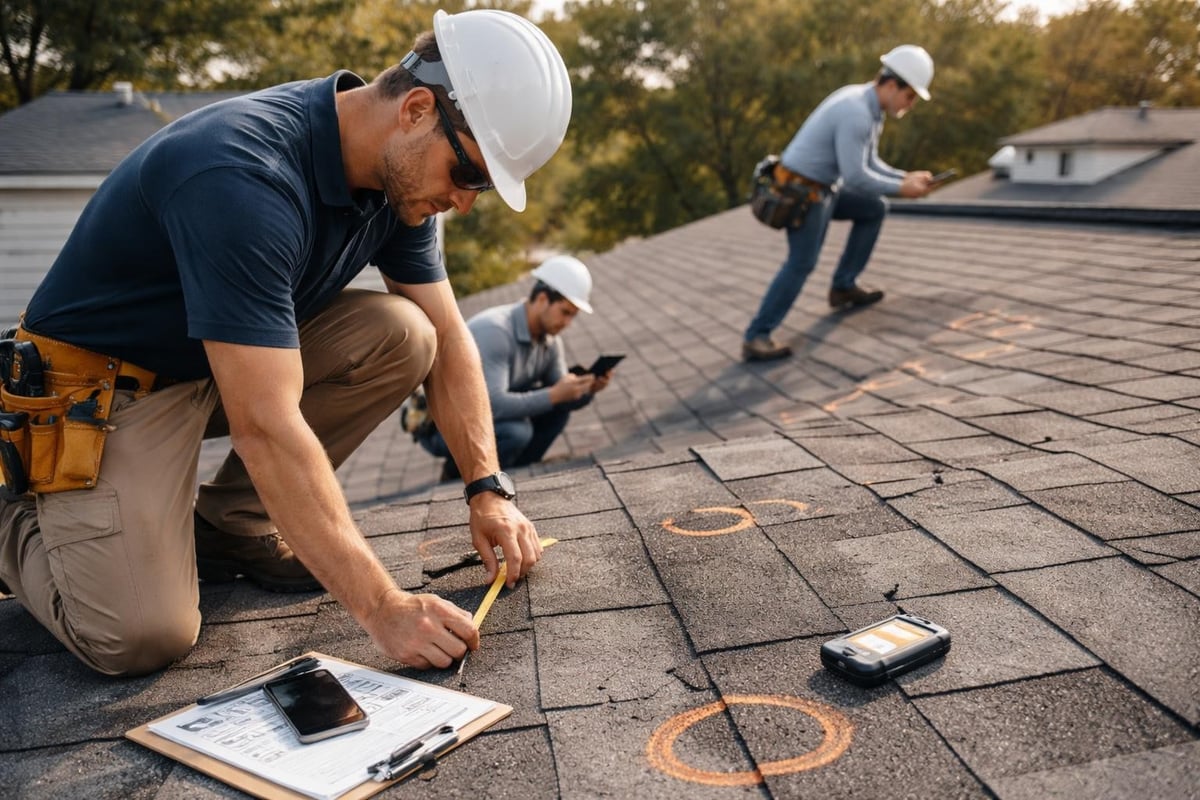
Professional contractors employ systematic inspection methods that cover entire roof systems. Walking patterns ensure complete coverage without damaging already compromised materials. Qualified inspectors examine not only field shingles but also critical components including ridge caps, valleys, flashing, vents, and penetrations where hail damage often concentrates.
Documentation goes beyond simple photographs. Detailed reports include:
- Damage location mapping with roof section identification
- Hail strike measurements and density calculations per roof section
- Comparative photos showing damaged versus undamaged areas
- Component-specific damage assessment for all roof elements
- Supporting weather data confirming hail size and storm timing
This thorough documentation supports insurance claims while providing property owners with clear understanding of damage extent and repair necessity. When situations require emergency roof repair in Fort Worth, this detailed assessment ensures temporary protection measures address the most critical damage first.
In-House Crews Versus Subcontractor Models
The crew structure contractors use significantly impacts project quality, timeline reliability, and accountability. Companies employing in-house crews maintain direct control over every aspect of work performance, from arrival times through cleanup standards. This model ensures consistent quality and streamlined communication throughout projects.
Subcontractor-dependent operations introduce variables that compromise reliability. Multiple layers of management separate property owners from the workers on their roofs. Quality control becomes inconsistent as different subcontractor crews bring varying skill levels and work standards. When problems arise, finger-pointing between general contractors and subcontractors delays resolution.
Quality Control and Accountability Advantages
In-house crews offer distinct advantages:
- Direct employee training and certification programs ensure consistent skill levels
- Company culture emphasizing quality extends to every crew member
- Unified communication channels prevent information gaps
- Immediate supervisor access addresses concerns as they arise
- Long-term employment relationships build institutional knowledge
Companies maintaining in-house teams also demonstrate financial stability and long-term commitment to their markets. The overhead investment in employee benefits, ongoing training, and equipment maintenance signals serious business operations rather than temporary ventures capitalizing on storm events.
Warranty Coverage and Long-Term Support
Comprehensive warranty protection separates quality contractors from operations planning quick exits. Professional hail damage roofing contractors back their work with substantial labor warranties that complement manufacturer material guarantees, creating complete coverage for property owners.
Labor warranties should extend at least five years and cover all installation-related defects. This includes improper fastener placement, inadequate sealing, ventilation errors, and flashing failures. Written warranty documentation should specify exactly what is covered, exclusion circumstances, and the process for obtaining warranty service.
Manufacturer warranties add another protection layer but only remain valid when installation follows specified guidelines. Many property owners discover too late that their contractor's improper installation voided manufacturer coverage, leaving them with worthless warranty certificates. Certified contractors authorized by roofing manufacturers guarantee installation compliance that preserves full manufacturer warranty protection.
Warranty Claim Processes
Understanding warranty claim procedures before problems arise prevents frustration when issues develop. Reputable contractors establish clear processes including:
- Designated contact methods for warranty claims with response time commitments
- Inspection scheduling within specific timeframes after claim notification
- Written determination of warranty coverage applicability
- Defined timelines for completing warranty repairs
- Documentation procedures for resolved warranty work
Local contractor presence becomes critical during warranty periods. Companies that have relocated or ceased operations cannot honor warranty commitments regardless of written guarantees. This reality reinforces the importance of selecting established local businesses with permanent facilities and long community histories.
Post-Storm Contractor Selection Timeline
After severe hailstorms damage roofs throughout neighborhoods, the rush to secure contractor services creates pressure that leads to poor decisions. Understanding appropriate timelines for each selection phase prevents hasty choices while ensuring timely damage mitigation.
Immediate actions focus on damage prevention rather than contractor selection. Tarping active leaks prevents interior damage escalation while property owners complete thorough contractor vetting. Most insurance policies allow reasonable time for repair arrangement without penalty, though specific timeframes vary by policy.
The contractor selection process should follow this sequence:
- Days 1-3: Document damage with photographs, contact insurance company, obtain emergency tarping if needed
- Days 4-7: Research contractors, verify credentials, check references, request initial inspections
- Days 8-14: Obtain written estimates from multiple qualified contractors, compare proposals
- Days 15-21: Review contracts carefully, clarify questions, verify insurance claim coordination
- Day 22+: Sign contract with selected contractor, schedule work around insurance approval
This timeline assumes normal circumstances. Properties with urgent signs requiring immediate emergency roof repair may need expedited processes, though credential verification and contract review remain essential even under time pressure.
Common Misconceptions About Hail Damage Repairs
Several persistent myths about hail damage and repair processes lead property owners toward poor decisions. Common misconceptions about hail damage roofing solutions include beliefs that all hail creates visible damage, that small hail cannot cause significant problems, and that repairs cost less than replacements in most cases.
Hail damage isn't always immediately visible to untrained observers. Bruising that compromises shingle integrity may not become apparent until months after storms when weathering accelerates deterioration at damage sites. This delayed recognition explains why professional inspections matter even when homeowners see no obvious problems.
The "repair versus replace" decision involves multiple factors beyond simple cost comparison. Patchwork repairs on roofs with widespread damage often cost more long-term than complete replacement. Insurance companies typically cover replacement when damage exceeds specific thresholds, making full reroofing the more economical choice despite higher initial scope.
Material Matching and Partial Replacement Challenges
Partial roof replacement introduces material matching difficulties that many property owners underestimate. Roofing manufacturers frequently discontinue specific product lines or modify formulations, making exact matches impossible years after original installation. Even when manufacturers still produce the same product line, color variations from different production runs create visible patchwork appearances.
Professional contractors address matching challenges through:
- Strategic replacement section planning that follows natural roof breaks
- Blending techniques that minimize visual transition lines
- Honest disclosure when perfect matches prove impossible
- Alternative approaches like replacing complete visible sections
Contractors who promise perfect matches for discontinued products either misunderstand the challenge or intentionally mislead clients. Transparent communication about matching limitations demonstrates professional integrity and prevents disappointment after project completion.
Evaluating Contractor Communication and Responsiveness
Communication quality throughout the contractor relationship predicts overall project satisfaction. Initial interactions reveal how contractors will behave during projects and afterward when warranty issues arise. Responsive, detailed answers to preliminary questions indicate respect for clients and commitment to transparency.
Professional contractors establish clear communication protocols including designated project managers, regular update schedules, and accessible contact methods. They explain technical concepts in understandable terms without condescension, answer questions thoroughly, and provide documentation supporting their recommendations.
Warning signs of communication problems include:
- Delayed responses to calls or emails beyond 24 business hours
- Vague answers that avoid specific details or commitments
- Reluctance to provide written documentation of verbal promises
- Pressure to make immediate decisions without adequate consideration time
- Dismissiveness toward homeowner questions or concerns
These communication red flags typically intensify once contracts are signed and deposits collected. Contractors who demonstrate poor communication during sales processes rarely improve after securing commitments.
The Role of Detailed Damage Documentation
Comprehensive damage documentation serves multiple critical purposes beyond insurance claims. Thorough records establish baseline conditions, support scope of work development, prevent disputes about what was damaged versus what already existed, and provide evidence if conflicts arise during or after projects.
Professional documentation includes:
| Documentation Type | Components | Primary Use |
|---|---|---|
| Photographic evidence | Wide shots, close-ups, reference markers | Visual damage proof for all parties |
| Written inspection reports | Damage descriptions, measurements, assessments | Detailed technical record |
| Scope of work documents | Specific repairs, materials, processes | Project planning and execution guide |
| Before/during/after photos | Progress documentation, completion verification | Quality control and final confirmation |
This documentation protects both property owners and contractors by establishing clear records of conditions, agreed work scope, and completed results. Understanding hail damage roof repair and insurance claims in Fort Worth demonstrates how proper documentation streamlines the entire restoration process from damage discovery through final insurance settlement.
Insurance Company Documentation Standards
Insurance carriers maintain specific documentation requirements for hail damage claims. Understanding these standards helps property owners work effectively with contractors to produce acceptable evidence. Most insurers require photographs showing overall roof condition, close-up damage images with measurement references, and documentation connecting damage to specific weather events.
Weather data supporting claimed storm dates strengthens documentation packages. National Weather Service reports, local news coverage, and meteorological databases provide objective evidence of hail size, timing, and affected areas. Qualified hail damage roofing contractors incorporate this supporting data into comprehensive claim packages that address adjuster requirements proactively.
Making the Final Contractor Selection Decision
After completing research, verifying credentials, and comparing proposals, property owners face the final selection decision. This choice should balance multiple factors rather than defaulting to lowest price or fastest availability. Long-term reliability, quality commitment, and local accountability typically outweigh modest cost savings or accelerated schedules.
Creating a decision matrix helps organize comparison criteria:
- Credentials and licensing (mandatory qualification)
- Insurance coverage adequacy (risk protection)
- References and reputation (past performance indicator)
- Communication quality (ongoing relationship predictor)
- Documentation thoroughness (professionalism measure)
- Warranty strength (long-term confidence)
- Crew structure (quality control factor)
- Local presence (accountability assurance)
- Price competitiveness (value consideration)
Weighting these factors according to individual priorities produces more objective decisions than emotional reactions to sales presentations. The contractor receiving the highest weighted score typically represents the best overall value even if not the cheapest or fastest option.
Trust your instincts when something feels wrong. Persistent unease about a contractor despite acceptable credentials often reflects subtle warning signs your subconscious detected. The roofing industry contains enough qualified professionals that property owners never need to ignore intuitive concerns about trustworthiness or competence.
Selecting qualified hail damage roofing contractors determines whether storm damage restoration protects your investment or creates ongoing problems requiring additional expense and frustration. The verification steps, documentation requirements, and evaluation criteria outlined above separate experienced professionals from opportunistic operators capitalizing on weather events. When Fort Worth properties require expert hail damage assessment, insurance claim support, and complete roof restoration, Texcore Construction delivers the accountability and craftsmanship that property owners need. Our in-house licensed crews, detailed documentation practices, and transparent communication ensure every project receives the careful attention that produces lasting results backed by comprehensive warranties.